
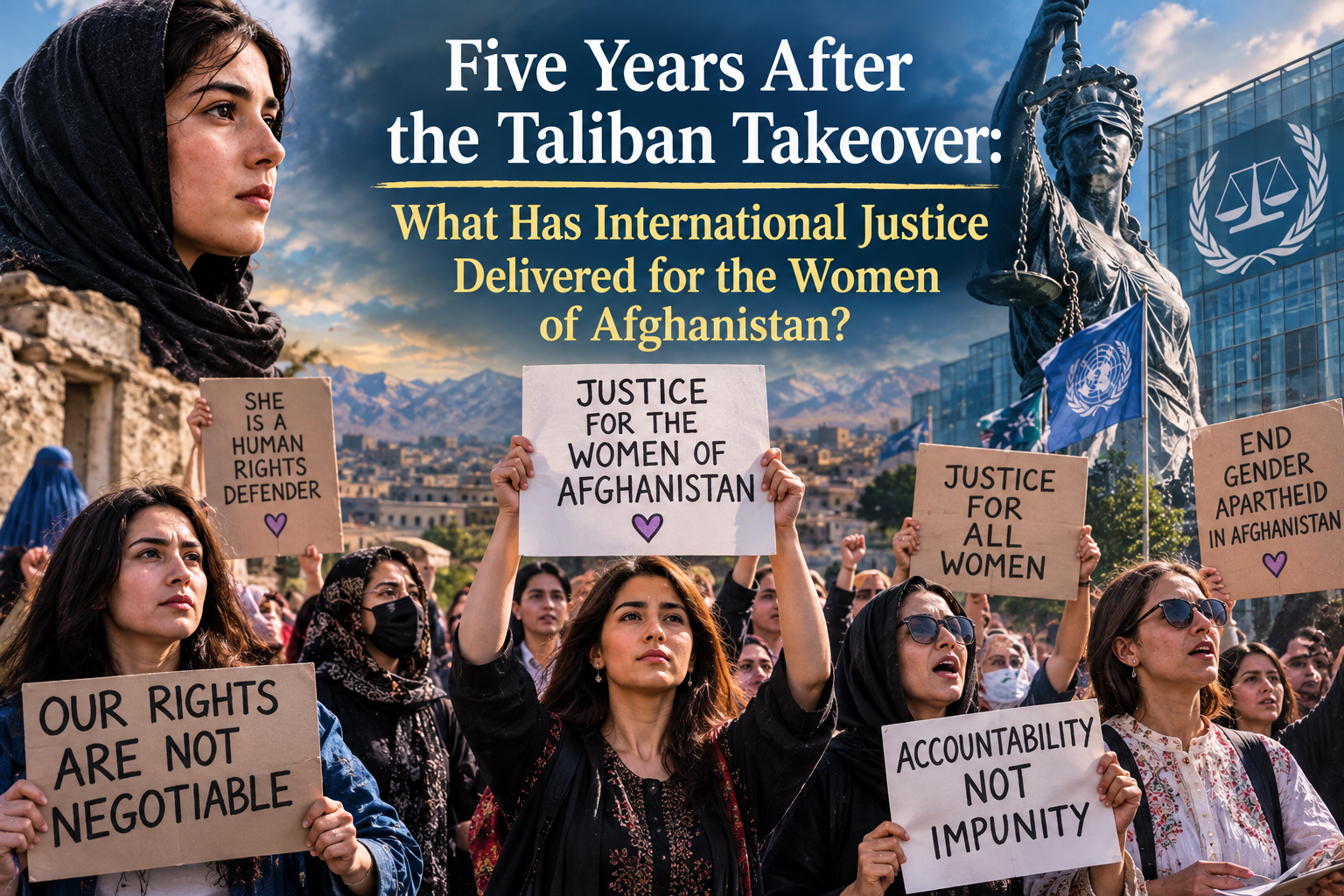
By: Fariha Easar1, International Human Rights Law Professional and Human Rights Defender
Five Years After the Taliban: From Recognition to Accountability
Five years of Taliban rule in Afghanistan have produced extensive documentation and increasingly clear recognition by the United Nations human rights mechanisms of systematic gender persecution. Yet meaningful accountability for those responsible remains limited. The International Criminal Court (ICC) arrest warrants against senior Taliban leaders now provide a concrete accountability pathway. The immediate challenge is whether States and international institutions will cooperate with the Court to secure meaningful accountability.
The human rights situation in Afghanistan has continued to deteriorate. Yet international accountability has not kept pace with the scale and persistence of the violations. The Taliban’s January 2026 Criminal Rules of Courts further formalize a legal system in which women and girls face severe restrictions and limited avenues for justice. The problem is not only the existence of discriminatory policies but their continued institutionalization within the legal and judicial system.
On July 8, 2025, the Office of the Prosecutor (OTP) of the ICC issued arrest warrants for the Supreme Leader of the Taliban Haibatullah Akhundzada and the Taliban’s Chief Justice Abdul Hakim Haqqani alleging persecution on the bases of gender. The arrest warrants also accuse the leaders of committing crimes against humanity by ordering, inducing, or soliciting the persecution of individuals who do not conform to the Taliban’s policies gender identity, or expression, as well as those targeted on political grounds, specifically individuals perceived as “allies of girls and women.” Although the ICC proceedings represent an important development in international accountability, they have the potential to shift the international response only if states demonstrate the political will to enforce arrest warrants and support further accountability efforts. i Now, the question is no longer whether the international community knows what is happening to women and girls in Afghanistan. The question is, will this knowledge and the legal mechanisms in place finally produce real consequences?
From Gender Discrimination to Gender Persecution
The scale and gravity of the Taliban’s discriminatory treatment of women and girls raise serious questions under 7(1)(h) of the Rome Statute. Article 7 recognizes persecution against an identifiable group on political, racial, national, ethnic, cultural, religious and gender as a crime against humanity. In addition, the Statute explicitly recognizes various sexual and gender-based crimes, including rape, sexual slavery, and forced pregnancy, as crimes against humanity and war crimes in international and non-international armed conflicts. In its policy on gender persecution, the ICC’s OTP interprets gender persecution as persecutory acts committed against individuals, regardless of whether they are male or female, due to their sex and/or socially constructed gender roles. The Amnesty International, among others, have argued that institutionalized nature of the Taliban’s inhuman acts amount to and should be recognized not only as gender persecution but also gender apartheid. If the Taliban’s systematic persecution of women and girls constitutes crimes against humanity of gender persecution and reflects an institutionalized system of gender apartheid, then the central question is no longer whether the world recognizes what is happening. It is whether the international community will act on what it already knows.
What Happens After an ICC Arrest Warrant Is Issued?
Under Chapter 9 of the Rome Statute, States Parties have obligations to cooperate with the ICC. Those obligations matter now because the court has issued arrest warrants against senior Taliban leaders. States should also support the preservation and collection of evidence. At the same time, international engagement with the Taliban has expanded, with States reopening diplomatic channels, increasing economic engagement, and exploring cooperation with Taliban authorities. Indeed, even as the Taliban continues to commit gender persecution and crimes against humanity, some States have reopened embassies in Afghanistan, engaged in trade deals with the de facto group, or granted diplomatic recognition to the Taliban. Similarly, the European Union has engaged the Taliban on question of migration. Such practices risk not only normalizing but legitimizing a regime engaged in widespread and systematic repression. This unprincipled engagement is not only contrary to the spirit of the Rome Statute but also inconsistent with broader human rights commitments. The ICC arrest warrants therefore create a practical test for States. Will governments treat the arrest warrants as binding legal obligations, or will diplomatic and political considerations take precedence when the Taliban leaders travel abroad? The answer will determine whether the arrest warrants have practical effect or remain largely symbolic.
Justice Must Reach Victims/ Survivors
Under both the Rome Statute and international human rights law, victims of grave human rights violations have the right to reparations, including restitution, compensation and rehabilitation. For victims of Taliban policies, realizing those rights presents serious practical challenges, particularly for women inside Afghanistan and those forced into displacement. These challenges make meaningful participation essential. Victims should help determine which forms of reparation respond to their harms and priorities.
Active participation of victims in reparations strengthens the legitimacy of those efforts and reflects victims lived experiences and priorities. Women from Afghanistan should therefore participate not only as victims, but as survivors, witnesses, documenters, lawyers, researchers, and human rights defenders. How can accountability be achieved if women of Afghanistan are excluded from designing the mechanisms intended to deliver justice to them?
What Should Happen Now?
ICC arrest warrants represent an important development, but their practical effect depends on state cooperation. Where states fail to arrest and surrender suspects, domestic courts exercising universal jurisdiction offer another pathway to accountability. Several jurisdictions have already used universal jurisdiction to prosecute international crimes committed in Syria and Iraq. Germany secured two landmark convictions. In 2022, a court in Koblenz convicted former Syrian intelligence officer Anwar Raslan for the crimes against humanity, including torture. This was described as the world’s first conviction for Syrian state torture. Later that year, the Frankfurt Higher Regional Court convicted Islamic State member Taha Al-Jumailly of genocide against the Yazidi community. These cases show that national courts still have a path to hold perpetrators accountable, even when the state where the crimes happened remains out of reach. Afghanistan presents a similar opportunity for universal jurisdiction, particularly because survivors and diaspora communities from Afghanistan are already outside the country to pursue accountability in foreign courts. These trials also show what justice can look like for survivors, not just perpetrators. In the Koblenz case, Syrian survivors took part. They asked questions. They submitted evidence. They gave closing statements in their own words. That is not a footnote to the trial. For many survivors, it was the trial. The women of Afghanistan should have the same standing, in the same courts, if a case is ever brought. Germany is where that precedent, Raslan and Al-Jumailly, was set. It is also a country Taliban officials have already entered, and a place where investigators could draw on evidence and testimony that women of Afghanistan have already given from exile. If universal jurisdiction is the path forward, victim participation must be built into it from the start, not added after the fact.
Additionally, for now, the two Taliban leaders indicted by the ICC are difficult to reach through this route. Akhundzada rarely leaves Kandahar, while Haqqani, who once led the Taliban’s negotiating team in Doha, has largely limited his travel to Afghanistan since becoming Chief Justice. But the wider network of officials who implement the persecution policy does cross borders. In June 2026, a five-member Taliban delegation led by Abdul Qahar Balkhi travelled to Brussels for talks with the European Union on migration and deportations. The delegation was allowed to enter Belgium and the talks went ahead, offering concrete test of whether universal jurisdiction could reach the Taliban officials outside Afghanistan. The Taliban Foreign Minister, Amir Khan Muttaqi has likewise travelled to Moscow, New Delhi, and Dubai. On the evidence side, much of the evidence and documentation concerning Taliban abuses is also held outside Afghanistan, including by the judges, prosecutors, lawyers, human rights defenders, and civil society organizations from Afghanistan who have fled the country. Therefore, states should condition diplomatic normalization and political concessions on concrete, verifiable improvements in the Taliban’s treatment of women and girls, without compromising accountability for international crimes.
Five years after the Taliban takeover, the problem is no longer a lack of evidence or legal mechanisms. It is whether States will use them. The ICC arrest warrants, the mechanisms preserving evidence, and the prospect of domestic prosecutions all offer pathways to accountability. Where States fail to enforce the ICC’s warrants, universal jurisdiction offers an important, complementary avenue. Whichever path is used, it must include meaningful participation and protection for the women and girls of Afghanistan. Five years on, the question is no longer whether the harm has been documented. It is whether these mechanisms will produce real consequences for those responsible, on terms set by the people they were meant to protect.
¹ The author gratefully acknowledges Professor Susana SáCouto for her feedback on earlier drafts of this article.
 IntLawGrrls
Leave a comment