The Universal Periodic Review (UPR) is a United Nations Human Rights Council mechanism that reviews each Member State’s human rights record every four and a half years. The process facilitates dialogue among States, produces recommendations, and seeks to improve human rights conditions, although its impact depends on national implementation. However, the effectiveness of the UPR ultimately depends on whether States implement those recommendations.
Unfortunately, the United States did not submit a national report and it refused to participate in its Review scheduled for November 2025. This refusal to engage in the UPR process was historic and U.S. participation in the rescheduled November 2026 Review remains uncertain. Consequently, U.S. civil society submissions for the UPR play a central role in documenting human rights conditions. In the absence of full State participation, civil society reporting becomes not merely supplementary, but essential to the legitimacy and functionality of the process.
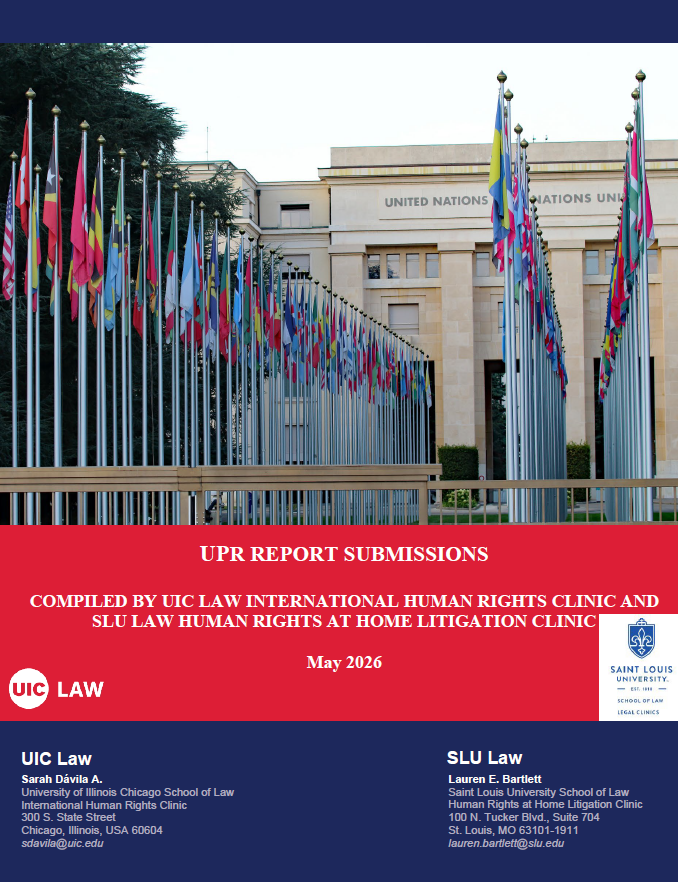
The International Human Rights Clinic at the University of Illinois Chicago School of Law (IHRC) and the Human Rights at Home Litigation Clinic at Saint Louis University (HRAHLC) prepared an unofficial summary of reports titled UPR Report Submissions. This summary compiles submissions from civil society (and other non-state actors) made in 2025 in connection with the Fourth Cycle of the UPR of the United States. As an aside, U.S. civil society was recently invited to make updates to their reports ahead of the rescheduled November 2026 Review of the United States. IHRC and HRAHLC hope to summarize those updates once they are made public this fall.
UPR Report Submissions consolidates a wide range of perspectives into a single, accessible resource, which can help identify recurring themes, patterns, and gaps across submissions. It does not attempt to present a comprehensive account of all developments. Instead, it provides a structured synthesis that supports engagement by advocates, affected communities, and the public. The U.S. civil society reports summarized in the UPR Report Submissions not unsurprisingly include a large number of reports highlighting human rights violations related to gender equality and women’s rights. The reports argue that the absence of U.S. ratification of the Convention on the Elimination of All Forms of Discrimination Against Women (CEDAW) and the lack of a constitutional ban on sex discrimination weaken women’s rights under United States law. Moreover, the reports make clear connections between reproductive rights, racial discrimination, and the prohibition against cruel, inhuman and degrading treatment or punishment. Several of the reports summarized also highlight violations of the rights of LGBTQIA+ persons. In consolidating these contributions, the UPR Report Submissions strengthens ongoing monitoring, highlights areas that require attention, and provides reference points for future advocacy.
Read more: UPR Report Submissions: An Unofficial Summary of U.S. Civil Society Submissions to the U.N. Human Rights Council in 2025 ahead of the U.S. Universal Periodic Review (UPR)The United Nations Human Rights Council and the Office of the High Commissioner on Human Rights have recently emphasized implementation of UPR recommendations. In fact, Human Rights Council Resolution 54/28 established the UPR Knowledge Hub, an online platform managed by the Office of the High Commissioner for Human Rights. The platform collects voluntary submissions on efforts to implement UPR recommendations and promotes the exchange of practices among States and stakeholders. It also provides civil society organizations with an additional avenue to promote peer learning and support among States and stakeholders transnationally.
It is in the spirit of such cooperative tools with a focus on implementation, that we recommend that the UPR Report Submissions not only as an organizational tool, but as a vital mechanism of accountability in a context where formal State engagement is uncertain. It underscores the increasingly important role of civil society in sustaining the UPR’s monitoring function and advancing the broader goal of human rights protection.


Leave a comment