
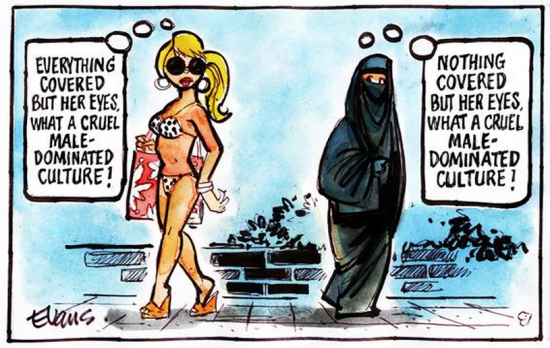
 The European Court of Human Rights ruled last week that France’s ban on wearing the full veil in public places did not contravene the European Convention on Human Rights. Although Article 9 of the Convention protects individual religious freedom, the freedom to manifest one’s religion can be limited if it is necessary for “public safety, for the protection of public order, health or morals, or for the protection of the rights and freedoms of others.” In S.A.S. v. France, the Court found that the French ban was a permissible restriction on religious freedom because it was undertaken for the “protection of the rights and freedoms of others.” The Court agreed with France that the full veil undermines the idea of “living together.” In other words, if some women wore a full veil, it would breach the rights of others to live in a space, which made socialization easier. This privileges the view that immigrants should assimilate in society over the notion that a country should embrace diversity. The dissenting opinion pointed out that that concept of “living together” is vague and should not outweigh a person’s religious freedom.
But one of the real issues motivating the ban was dismissed by the Court without much discussion. Many argue that the hijab is repressive to women and banning it would enhance women’s equality. Others have argued that this position denies agency to individual women who choose to veil. The Court rejected France’s argument that the ban was necessary for women’s equality, because it noted that it was a woman who was challenging the ban. Indeed, the petitioner argued that it was emancipating for her to wear the veil.
In justifying its decision, the Court relied on a 2005 decision where it found that Turkey’s ban on headscarves in educational institutions did not violate religious freedom, because it was undertaken for the purpose of promoting democracy and secularism. However, when considering whether or not the full veil or headscarf is repressive to women, the country context is rarely taken into account by commentators. In other words, a ban in one country may violate human rights, but it might not in another country. Thus, just because the Court found Turkey’s headscarf ban permissible, it doesn’t automatically follow that France’s ban is also legitimate.
Amnesty International, Open Society Justice Initiative and a host of other organizations submitted briefs opposing the full veil ban in France. But if Saudi Arabia (a stark example) bans the hijab (which will never happen), would these groups object? Probably not. In that country, the hijab is common practice and there is societal pressure for women to wear it. Whereas in France, some woman have argued that the veil is an assertion of their identity as Muslim and distinguishes them from the majority group. Additionally, when a state that is Muslim-majority bans the headscarf (like Turkey), there may be different motivations at play than when a state like France (where Muslims are a minority) bans the hijab. When discussing the question of whether or not the veil ban promotes women’s equality, it is important to take the country context into account. Even if we assume that the full veil is repressive to women in certain countries, when that practice is imported into another country by immigrants, its significance changes.


 IntLawGrrls
Leave a reply to Bri Lee Cancel reply