Write On! Intersection Rewrites Project Blog Symposium

This installment of Write On!, our periodic compilation of calls for papers, includes calls to submit at the Intersectional Rewrites project, as follows:

►The Intersectional Rewrites project is hosting a blog symposium, dedicated to examining the role intersectional analysis plays and could play in the case law of the European Court of Human Rights. This blog symposium is designed to complement the Intersectional Rewrites book project by providing an open space for creative thinking on the issues in relation to a wider range of case law than can be covered in the book.  

Call for submissions

We invite submissions of blogs of no more than 1,500 words. Blogs should be submitted in English, by 31 October 2023, to blogsymposium@systemicjustice.ngo. A group of authors and editors of Intersectional Rewrites will select blogs for publication and offer editorial support. We expect blogs to appear on the website from January 2024.  

There is no restriction on authors, we invite: students, academics, practising lawyers, and anyone else interested in the subject to submit a blog. The only limitation on subject matter is that blogs should relate to the European Court of Human Rights and the critical paradigm of intersectionality. We expect bloggers will want to have a go at rewriting small parts of judgments or critique specific rulings, but we welcome other approaches. If you have doubts about your planned approach, feel free to get in touch.  

The Intersectional Rewrites website will publish blogs on a dedicated page. Blogs will remain on the website as long as the site remains active. All blogs will be published under the Creative Commons BY SA 4.0 license, meaning that users of the website are allowed to read, download, copy, distribute, print, search, or link to the full texts of the blogs, or use them for any other lawful purpose, without asking prior permission from the publisher or the author as long as they cite the source. 

Please visit the Intersectional Rewriters website here for more information.

Work On! Feminist Theory Workshop

Work On! is an occasional item about workshops, roundtables, and other fora that do not necessarily include publication:


► The Feminist Theory Workshop (FTW), which is now in its sixteenth year, offers a unique opportunity for scholars to engage in sustained dialogue about feminist theory as a scholarly domain of inquiry. The workshop will be held March 22-23, 2024 at Duke University in Durham, NC.  The “workshop” approach of this conference requires active participation of both presenters and attendees. The FTW consists of seminars led by visiting scholars, keynote lectures, and roundtable discussions. Our keynote speakers for 2024 are Grace Kyungwon Hong, Professor of Gender Studies at UCLA; Julie Livingston, Professor of Social and Cultural Analysis and History at New York University; Jasbir Puar, Professor of Women’s, Gender, and Sexuality Studies at Rutgers University; and Kevin E Quashie, Professor of English at Brown University; in addition to special guests who will serve on the closing roundtable.

The Feminist Theory Workshop (FTW) hosts participants from institutions all over the globe, as these diverse voices continue to be crucial to the workshop’s drive to understand feminist theory across both disciplinary and national boundaries. We are offering awards of up to $1,500 to enable the participation of post-graduate and post-doctoral emerging scholars from outside the United States. The awards are to fund the travel expenses of scholars coming from institutions outside the US to attend the workshop. NO payment of any funds will be made to any individual. Gender, Sexuality and Feminist Studies (GSF) will make direct payments to the contracted travel agent for the approved travel expenses. The FTW provides some meals at the conference and there are NO registration fees to attend. Attendees are responsible for their own lodging and additional transportation arrangements.

Eligibility Requirements: 

  1. STATUS:  Ph.D. students and postdoctoral scholars
  2. CITIZENSHIP: Non-US citizens
  3. RESIDENCE: Resides outside the United States
  4. AWARDEE:  Previous FTW International Travel Award recipients are ineligible to apply.

Application Requirements:

  1. Complete online application here.
  2. Upload CV
  3. Upload essay (500 words) regarding the following:
    • What you do hope to gain from the workshop?
    • What do you believe you can contribute to the FTW?
    • How might your perspectives be unique for audience participants here at Duke?

Award Recipient Requirements: 

  1. Sign and return the acceptance letter.
  2. Register for the Feminist Theory Workshop Conference.
  3. Work with contracted travel agent and GSF staff to secure travel by given deadline.
  4. Prepare a report about report their experience at the workshop.

Applications are due no later than Monday, October 31, 2023, EST 12am, midnight.

If Black Were White: The Impact of Racial and Cultural Biases on the Ongwen Trial Judgment

Abstract from unpublished paper (© 2023 Beth S. Lyons.  All rights reserved)

Dominic Ongwen was abducted in 1987 by the Lord’s Resistance Army (‘LRA’) in Northern Uganda when he was 8 or 9 years old and trafficked as a child soldier; he made multiple unsuccessful attempts to escape, and finally succeeded in 2015.  He turned himself in to the International Criminal Court in 2016.  Mr. Ongwen’s defence was that he was not responsible for the crimes of the LRA, based on his mental illnesses and duress, stemming from his abduction and subsequent coercion and indoctrination under Joseph Kony within the LRA.  In February 2021, Trial Chamber IX convicted Dominic Ongwen of 61 charges and two modes of liability.  He was sentenced to 25 years incarceration.  The Trial Judgment was affirmed by the Appeals Chamber in December 2022.

My contention is that if the LRA were a predominantly white cult, or if it functioned in a predominantly white/European country, or if the Defence expert psychiatrists from Uganda were white or if the client, Mr. Dominic Ongwen, were white, the Trial Chamber would have reached a different conclusion about the affirmative defences of mental disease and duress and acquitted him.

This article critiques the judicial racial and cultural biases in the Ongwen Judgment, as related to the affirmative defence of mental disease or defect.  These biases blinded the judges, and prevented them from assessing the evidence in an impartial manner and correctly applying the law.  They were a significant factor in the Trial Chamber’s rejection of Mr. Ongwen’s affirmative defences, mental disease or defect and duress.

For the ICC to be a respected and legitimate organ of international justice, it must apply the rule of law to all, and ensure fairness in its proceedings.  This means, in part, confronting its racial and cultural biases within its structure, as well as within the decisions and judgments which it renders.

*********************************************************************************************

Note to reader:  I am one of the defence counsel in the Ongwen case at the ICC.  The above abstract is from an unpublished paper which I have submitted to a number of law journals.  The paper is quite long (about 26,000 words with footnotes), and exceeds the length requirement of most law journals.   If you have any suggestions for publication, I’d be grateful.  Thanks.  Please contact me at bethlyons@aol.com.

Write On! Call for Papers: The African Renaissance in the Age of Globalization

This installment of Write On!, our periodic compilation of calls for papers, includes calls to submit at University of Padua, Italy, as follows:


► The University of Padau, Italy, is calling for papers for the conference The African Renaissance in the Age of Globalization. What Role for International Investment Law? The event is set to take place on 10-11 November at the University of Padua, Italy, and is organized by the Department of Political Science, Law, and International Studies. The workshop will provide a platform for researchers and policymakers to discuss new research and identify areas where further academic and policy-oriented work is needed. There will be an open floor discussion.

The concept of the African Renaissance expresses the idea that the African continent shall overcome the current challenges of poverty, inequality, and violence and achieve cultural, political, and economic renewal and a more just and equitable order. First articulated by the Senegalese historian Cheikh Anta Diop (1923–1986) in the aftermath of WWII, the concept encourages African peoples to take pride in their rich cultural heritage, to take charge of their lives, and to set Africa as a significant player in international affairs. It also encourages them to rebuild the economy. The African Renaissance should start a new era following decolonization and the parallel spread of democracy and the rule of law across the continent.

Yet, even after the end of colonization in the early 1960s, violent political events and ethnic conflicts have plagued the African continent, causing millions of deaths and hampering economic development. The recent pandemic has highlighted vulnerabilities in infrastructures and essential services. Investments in the extractive industries have rarely benefitted local communities, leaving a legacy of environmental damage instead. Finally, climate change has increased desertification processes, drought,
and famine, thus determining massive migration flows and contributing to African diasporas.

Can the ambitious dream of the African Renaissance be brought to fruition? Can peace and prosperity be fulfilled? What role can international investment law play in helping African peoples tackle the challenges to Africa’s growth and prosperity? The conference aims to address these questions seeing Africa as a continent of hope and emancipation. It constitutes a platform to critically assess the promises and pitfalls of existing investment treaties and build momentum for dialogue on the future of Africa. Foreign investments are crucial, especially for Least Developed Countries (LDCs), whose sustainable development often depends on foreign assets and technology. Out of 46 LDCs, 33 are in Africa. The challenge is to strike a balance between the promotion of foreign direct investments and the right and duty of the host countries to pursue public interest.

Submission Details:

Proposals for papers of twenty minutes, should be sent to the conference organizers tarcisio.gazzini@unipd.it and valentina.vadi@unipd.it by 15 July 2023. Proposals should include a short abstract of the paper (500 words) and an author CV. The authors will be notified about acceptance by the end of July. The workshop will take place on 10–11 November 2023 at the Department of Political Science, Law, and Political Studies of the University of Padua. Selected authors will be invited to submit the first full draft of their paper (8000 words) by that date. The event will be held in person. There is no registration fee. Accommodation expenses will be covered for the speakers. The actual cost of the speakers’ travelling expenses may be reimbursed to the maximum ceiling of €300 per person upon presentation of receipts after presenting at the workshop. The publication of the conference proceedings will be sought in the form of a special issue with an international peer-reviewed journal or an edited volume with an international Publisher.

Proposals are particularly welcome on the following topics:
• Permanent sovereignty over natural resources;
• Protection of foreign investments during or in the aftermath of the pandemic;
• Police powers doctrine and investments in Africa;
• Promoting foreign investments in the African health sector;
• Intellectual property and technology transfer in international investment law;
• Protecting African traditional knowledge in the investment context;
• Protecting African geographical indications;
• Investing in African agriculture;
• Digitizing microfinance loans in Africa: Investing in Women Transforming Lives;
• Investing in African Cultural Heritage.

Write On! Call for Submissions — National Law University, Jodhpur, India

This installment of Write On!, our periodic compilation of calls for papers, includes the following from the National Law University, Jodhpur, India for the Trade, Law and Development Journal:

► The Editors of the Trade, Law and Development Journal at the National Law University, Jodhpur, India, one of the premier law schools of India, are now inviting unpublished manuscripts for publication of its 15th General Issue (Vol. 15 No.2, Winter ’23 Issue) based on contemporary developments in world trade, international economic law, cross-border investment, and development, among other inter-related aspects of international law. Submissions are welcome in the form of Articles, Notes, Comments and Book Reviews.

Trade, Law and Development is a peer reviewed journal published by the University, based on, inter alia, International Trade Law and International Economic Law. The Journal has been consistently ranked as the best law journal in India across all fields and the 10th best journal in the field of World Trade globally by the Washington and Lee University Rankings (USA).

Manuscripts received by August 05, 2023, pertaining to any area within the purview of international economic law will be reviewed for publication in the Winter ’22 issue. More information can be found on the Journal’s website here. Manuscripts may be submitted via e-mail or via the Journal’s website here.

LAST DATE FOR SUBMISSIONS: AUGUST 05, 2023

In case of any queries, please feel free to contact us at: editors@tradelawdevelopment.com.

More details about the journal and the submission process can also be found in the document below.

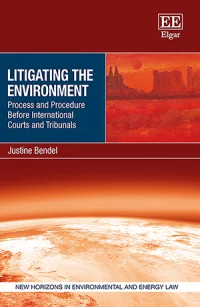
Read On! Litigating the Environment: Process and Procedure Before International Courts and Tribunals

► Providing an insightful contribution to literature on the topic, this book scrutinises how international courts and tribunals may respond procedurally to an ever-growing list of environmental disputes. In a time of environmental crisis, it lays crucial groundwork for strengthening the application of international environmental law, a topic of increasing relevance for global civil society.

More details about this title can be found here.

Justine Bendel, Marie Skłodowska-Curie Fellow, University of Copenhagen, Denmark and Lecturer, University of Exeter, UK.

Golan v. Saada: One Year Later

On June 15, 2022, the U.S. Supreme Court issued an opinion in its fifth Hague Abduction Convention case, Golan v. Saada.  The case addressed a heavily litigated point of law under this Convention: whether a court must consider ameliorative measures to safely return an abducted child despite the Respondent Parent successfully proving that such a return would expose the child to a grave risk of harm in the habitual residence.  Ultimately, the Supreme Court agreed with neither party, instead aligning with the position of the U.S. government, concluding that a court cannot be required to consider ameliorative measures, but may do so, in an exercise of discretion.  In issuing its opinion, Justice Sotomayor gave some guidance to lower courts in how to approach these cases going forward.  First, while the judge has no obligation to consider these ameliorative measures, “it ordinarily should address ameliorative measures raised by the parties or obviously suggested by the circumstances of the case, such as in the example of a localized epidemic.”  Second, if the judge does consider ameliorative measures, that judge “must prioritize the child’s physical and psychological safety”, “should abide by the Convention’s requirement that courts addressing return petitions do not usurp the role of the court that will adjudicate the underlying custody dispute”, and “must accord with the Convention’s requirement that courts ‘act expeditiously in proceedings for the return of children.’” When ameliorative measures are at issue in a case, they could range from a parent voluntarily undertaking certain obligations upon the child’s return (such as refraining from contact, paying support, or providing resources), to existing resources in the home country (such as “access to legal services, financial assistance, housing assistance, health services, shelters and other forms of assistance or support to victims of domestic violence, as well as responses by police and through the criminal justice system.”) See the Hague Conference’s Guide to Good Practice on Article 13(b), para. 43, et. seq.

Now, one year on from the Supreme Court’s opinion, litigants are settling in to the new standard. Just over one month after the Golan v. Saada opinion, the U.S. District Court for the Southern District of New York applied the new standard in Braude v. Zeirler.  The Respondent Mother argued, and the court found, the exception of a grave risk based on the Petitioner Father’s “untreated mental health issues, history of domestic violence and coercive conduct, and access and possession of child pornography …”. The Petitioner Father argued that he consented to eight separate ameliorative measures, ranging from no contact with the Respondent, to therapy, to taking prescription medications, to residing with his parents, to complying with requirements put forth by the child services agency in Canada.  Since a party raised ameliorative measures, the court “should” consider them, and this court did, following the scheme set forth in Golan v. Saada.  In doing so, the Court concluded that the ameliorative measures failed to “adequately address Petitioner’s lack of serious mental health treatment.” Further, none of them addressed “Petitioner’s history of aggressive behavior and coercive control.”  Lastly, “none of the measures adequately protect the children from Petitioner’s pedophilia.”  The district court therefore denied the Petitioner’s request to return the children, and the Second Circuit affirmed the district court’s order.

The U.S. District Court for the District of Colorado likewise examined ameliorative measures when a 15-year-old child advised the judge, in an in-camera interview, that she had been sexually abused by her father and felt her mother would not protect her.  In Johnson v. Johnson, the district court found insufficient evidence that the Petitioner Father would move out of the family home upon the child’s return, that the Bahamian law enforcement would conduct a thorough or impartial investigation, and that the Petitioner Parents would not place their daughter into a hospital or institution upon her return, for having embarrassed them in this litigation.

The U.S. District Court for the District of Arizona discussed ameliorative measures after the U.S. Supreme Court vacated and remanded a return order based on the Golan v. Saada opinion.  In this case, Radu v. Shon, the district court had ordered the parties’ children returned to Germany several times, at times with the ameliorative measure that their Respondent Mother return with them. Approximately two months after the Golan v. Saada opinion, when on remand, the district court again ordered the children’s return, concluding that “the ameliorative measure set forth in its December 30, 2021 Order – namely, that Respondent return with OSR and MSR to Germany – satisfies the requirements outlined in Golan.”  The court entered this order without an evidentiary hearing, finding that holding one would cause additional delay.  The Respondent Mother appealed to the Ninth Circuit again, and the Ninth Circuit affirmed the return order in March 2023 in Radu III.  A key issue that Respondent Mother has indicated she plans on putting back before the U.S. Supreme Court relates to how the district court gathered information about ameliorative measures.  Namely, the district court had initiated contact with the U.S. Central Authority for the Hague Abduction Convention, which connected the judge with the German Central Authority, to gather information about proceedings and resources in Germany to protect the children. Note that the Hague Conference’s Guide to Good Practice on Article 13(b) states, “[i]n line with the relevant laws and procedures and where it is deemed appropriate in evaluating assertions of grave risk, courts can seek additional information through Central Authorities in order to better understand the legal framework or child protection system in place in the State of habitual residence, or to clarify certain assertions of facts.” (para. 91).  The Guide stresses that the Central Authority is not to evaluate assertions of grave risk.  Central Authorities have a responsibility under the Convention to “cooperate with each other and to promote cooperation among internal authorities to secure the prompt return of the child …”. (para. 96)

Perhaps the most illustrative application of the Golan v. Saada opinion was in Saada v. Golan itself, upon remand. On August 31, 2022, the U.S. District Court for the Eastern District of New York again ordered the parties’ minor child returned to Italy after the Supreme Court vacated the prior return order and remanded the case for review under its new jurisprudence. The district court concluded that the Saada/Golan family’s circumstances “obviously suggested” a review of ameliorative measures, and that the court had extensively examined such ameliorative measures at the original trial, even going so far on a prior remand to request the parents seek a protective order from the Italian courts that would be implemented when the child was returned.  Therefore, the district court again ordered the minor child returned to Italy.  At present, the case is in a brand-new posture, with the original Respondent Mother having passed away in October 2022, and a new Respondent Aunt being substituted.  Both parties have been filing new pleadings, making additional assertions and arguments for the court to consider.  To date, the court has not yet rendered a new decision on the Respondent Aunt’s current retention of the child in New York.  In its most recent proceedings, the court requested a member of the International Hague Network of Judges in the United States to prevail upon their Italian counterpart for additional information about ameliorative measures that exist in Italy if the child were returned, including the posture of the custody litigation in Italy, the potential for social services to be involved, and the intervention by family in Italy to care for the child in lieu of foster care.  Right now, the parties are hurling various allegations against one another, but the judge has not made any factual findings or rendered a new opinion on the Petitioner Father’s request to return the child to Italy.

Therefore, to date, it appears from the cases that have been heard since Golan v. Saada, judges are recognizing their discretion to consider ameliorative measures, and are doing so when counsel/a party presents evidence of such a measure or it is obviously suggested by the circumstances in the case, including when there are allegations of domestic violence.  A consideration of ameliorative measures is not a foregone conclusion that the child will be returned.  Competent counsel has been tending to raise ameliorative measures as soon as a Respondent Parent asserts a grave risk argument, meaning that the grave risk and ameliorative measures are routinely considered at the same trial as part of a full analysis.  It also seems that judges will become more accustomed to using the resources available to them, namely the Central Authorities and International Hague Network of Judges, to gather information about ameliorative measures. 
Read On! The Regulation of Intelligence Activities under International Law

► Presenting a thorough examination of intelligence activities in international law, Sophie Duroy provides theoretical and empirical justifications to support the cutting-edge claim that states’ compliance with international law in intelligence matters serves their national security interests. This book theorises the regulation of intelligence activities under international law, identifying three layers of regulation: a clear legal framework governing intelligence activities (legality); a capacity to enforce state responsibility (accountability); and the integration of legality and accountability into responsive regulation by the international legal order (compliance).

Sophie Duroy, Fellow, KFG Berlin-Potsdam Research Group ‘The International Rule of Law: Rise or Decline?’, Berlin, Germany.

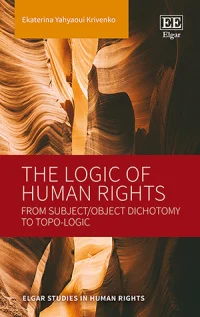
Read On! The Logic of Human Rights: From Subject/Object Dichotomy to Topo-Logic

► Conceptualizing the nature of reality and the way the world functions, Ekaterina Yahyaoui Krivenko analyzes the foundations of human rights law in the strict subject/object dichotomy. Seeking to dismantle this dichotomy using topo-logic, a concept developed by Japanese philosopher Nishida Kitarō, this topical book formulates ways to operationalize alternative visions of human rights practice.

Subject/object dichotomy, Yahyaoui Krivenko demonstrates, emerges from and reflects a particular Western worldview through a quest for rationality and formal logic. Taking a metaphysical and epistemological perspective, this book explores the alternative views of reality and logic, developed by Kitarō, to demonstrate how topo-logic can enable both a theoretical and a practical renewal of human rights and overcome the subject/object dichotomy. Examining the recent growth of social movements, decolonization and diversification of discourses about human rights, and substantive equality, the book identifies these developments in contemporary human rights as indications of a movement towards a topo-logical view beyond the subject/object dichotomy.

More information can be found here.

Ekaterina Yahyaoui Krivenko, Associate Professor, Irish Centre for Human Rights, School of Law, University of Galway, Ireland.

Read On! Art and Human Rights: A Multidisciplinary Approach to Contemporary Issues

► This timely book builds bridges between the notions of art and aesthetics, human rights, universality, and dignity. It explores a world in which art and justice enter a discussion to answer questions such as: can art translate the human experience? How does humanity link individuality and community building? How do human beings define and look for their identity? The fields of human rights and art are brought together in order to open the discussion and contribute to the promotion and protection of human rights. More information can be found here.

Edited by Fiana Gantheret, Expert and Consultant in International Justice and Human Rights, Founder and Director of Creating Rights, Nolwenn Guibert, Senior Legal Officer at an international organization, Geneva, Switzerland and Sofia Stolk, Assistant Professor, VU Amsterdam, the Netherlands.