Nobel Peace Prize for 2023- Press Release

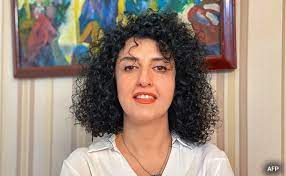
The Norwegian Nobel Committee has decided to award the Nobel Peace Prize for 2023 to Narges Mohammadi for her fight against the oppression of women in Iran and her fight to promote human rights and freedom for all.

“Zan – Zendegi – Azadi”
“Woman – Life – Freedom”

The Norwegian Nobel Committee has decided to award the Nobel Peace Prize for 2023 to Narges Mohammadi for her fight against the oppression of women in Iran and her fight to promote human rights and freedom for all. Her brave struggle has come with tremendous personal costs. Altogether, the regime has arrested her 13 times, convicted her five times, and sentenced her to a total of 31 years in prison and 154 lashes. Ms Mohammadi is still in prison as I speak.

In September 2022 a young Kurdish woman, Mahsa Jina Amini, was killed while in the custody of the Iranian morality police. Her killing triggered the largest political demonstrations against Iran’s theocratic regime since it came to power in 1979. Under the slogan “Woman – Life – Freedom”, hundreds of thousands of Iranians took part in peaceful protests against the authorities’ brutality and oppression of women. The regime cracked down hard on the protests: more than 500 demonstrators were killed. Thousands were injured, including many who were blinded by rubber bullets fired by the police. At least 20 000 people were arrested and held in regime custody.
The motto adopted by the demonstrators – “Woman – Life – Freedom” – suitably expresses the dedication and work of Narges Mohammadi. 

Woman. She fights for women against systematic discrimination and oppression.

Life. She supports women’s struggle for the right to live full and dignified lives. This struggle across Iran has been met with persecution, imprisonment, torture and even death.

Freedom. She fights for freedom of expression and the right of independence, and against rules requiring women to remain out of sight and to cover their bodies. The freedom demands expressed by demonstrators apply not only to women, but to the entire population.

In the 1990s, as a young physics student, Narges Mohammadi was already distinguishing herself as an advocate for equality and women’s rights. After concluding her studies, she worked as an engineer as well as a columnist in 
various reform-minded newspapers. In 2003 she became involved with the Defenders of Human Rights Center in Tehran, an organisation founded by Nobel Peace Prize laureate Shirin Ebadi. In 2011 Ms Mohammadi was arrested for the first time and sentenced to many years of imprisonment for her efforts to assist incarcerated activists and their families.

Two years later, after her release on bail, Ms Mohammadi immersed herself in a campaign against use of the death penalty. Iran has long been among the countries that execute the highest proportion of their inhabitants annually. Just since January 2022, more than 860 prisoners have been punished by death in Iran.

Her activism against the death penalty led to the re-arrest of Ms Mohammadi in 2015, and to a sentence of additional years behind walls. Upon her return to prison, she began opposing the regime’s systematic use of torture and sexualised violence against political prisoners, especially women, that is practised in Iranian prisons.

Last year’s wave of protests became known to the political prisoners held inside the notorious Evin prison in Tehran. Once again, Ms Mohammadi assumed leadership. From prison she expressed support for the demonstrators and organised solidarity actions among her fellow inmates. The prison authorities responded by imposing even stricter conditions. Ms Mohammadi was prohibited from receiving calls and visitors. She nevertheless managed to smuggle out an article which the New York Times published on the one-year anniversary of Mahsa Jina Amini’s killing. The message was: “The more of us they lock up, the stronger we become.” From captivity, Ms Mohammadi has helped to ensure that the protests have not ebbed out.

Narges Mohammadi is a woman, a human rights advocate, and a freedom fighter. In awarding her this year’s Nobel Peace Prize, the Norwegian Nobel Committee wishes to honour her courageous fight for human rights, freedom, and democracy in Iran. This year’s Peace Prize also recognises the hundreds of thousands of people who, in the preceding year, have demonstrated against the theocratic regime’s policies of discrimination and oppression targeting women. Only by embracing equal rights for all can the world achieve the fraternity between nations that Alfred Nobel sought to promote. The award to Narges Mohammadi follows a long tradition in which the Norwegian Nobel Committee has awarded the Peace Prize to those working to advance social justice, human rights, and democracy. These are important preconditions for lasting peace.    

Oslo, 6 October 2023
 

In honor of Thomas Buergenthal

Judge Buergenthal championed the cause of humanization of international law and human rights education at the early level to prevent genocide and crimes against humanity. Here is his 2008 interview in which he discusses the creativity of international courts, the value of provisional measures, the backlog of human rights cases at the regional courts, the complexity of humanitarian intervention, the need to regulate multinational corporations and NGOs in relation to human rights, the role of truth commissions as a complement to criminal courts, and the need for “shame campaigns” to underscore children’s rights. He declares that the world would have benefited from a truth commission for Germany after WWII in order to understand why Hitler came to power; given the current war in Ukraine, his reflections remain timely.

He was my professor of human rights law at GW and it was an honor to have been his student. He assigned the crisis situation of refugees arriving from Haiti as the exam question. He inspired me to challenge my students to analyze contemporary dilemmas and to recognize the need for shared empathy across borders.

Peace and Solidarity: Dilemmas of the Evolution of International Law in An Age of Decoupling

I presented my research to the North South Webinar Series, based on my previous Research Handbook on International Law and Peace (Edward Elgar 2019) and my forthcoming Research Handbook on International Law and Solidarity (Edward Elgar 2023). I will discuss the normative evolution of these third generation rights, the link to the UN Report Our Common Agenda, solidarity paradoxes in an age of decoupling and recoupling, as well as securitized peace and solidarity. There is a role for peace and solidarity in the context of transitional justice, and hence relevant to intractable conflicts like Palestine in which peace and solidarity civic society spaces are under threat. I argue for a pro homine peace and solidarity that is gendered, intergenerational, and inclusive. Peace and Solidarity are both means and ends as they call for pacific settlement of disputes, recognition of the right to freedom of expression (including digital access) and equitable participation and benefit in the common heritage of mankind. The lecture is available here

Asylum for Conscientious Objectors, Deserters, and Draft Evaders

There has been some confusion regarding the right of Russian conscientious objectors, deserters, and draft evaders to apply for asylum. Conscientious objectors may object to the illegality of the war (jus ad bellum), the commission of war crimes (jus in bello), as well as corruption and human rights violations in the context of war. Deserters may develop a conscientious objection after deployment. Draft evaders may have a conscientious objection or may be subject to discriminatory conscription (on account of ethnicty or other identity) or may be subject to excessive or arbitray punishment (such as excessive imprisonment or other penalty). UNHCR has Guidelines on Asylum and Military Service, they are available here

Solidarity Activism in a time of Unpeace

For inspiration from amazing women who work for solidarity actions to assist the dis-empowered and vulnerable persons, including refugees, minorities, persons subjected to solitary confinement, and victims of atrocity crimes seeking truth, please see the video from the 2022 ASIL Roundtable including Noura Erakat, Maha Hillal, Azadeh Shashahani, Nia Houston, chaired by Cecilia Bailliet. The video is available here

A Judge for Humankind Antônio Augusto Cançado Trindade

The recognition of a global shift in international affairs is marked by the passing of Judge Antônio Augusto Cançado Trindade. His quest to pursue of the emancipation of those most vulnerable from oppression, including refugees, minorities, indigenous people, the environment, was articulated as the manifestation of a universal juridical conscience. He explained how human rights violations had a transcendental scope of traumatic impact upon individuals beyond the time of detention, the suffering of the families of victims subject to forced disappearance or torture, and the anguish of societies denied reconciliation after internal conflict via structures of impunity seeking to bury historical recognition of atrocity crimes. His analysis grounded the evolution of human rights law through articulation of the right to truth, the right to a life’s project, and characterization of non-discrimination as a jus cogens norm, as well as recognition of the rights to peace and development. He supported the aim of achieving a world committed to disarmament and protection of the common heritage of mankind. He warned that the focus on individual criminal accountability should not distract from the equally important recognition of state accountability of atrocity crimes. Fundamentally, he viewed the role of the international judge as carrying a responsibility to create spaces of freedom for individuals and marginalized groups in the face of repression thereby humanizing international law. I had the privilege of interviewing him in 2011 and his illuminating perspectives are available here.

Go On! Book Discussion: The Construction of the Customary Law of Peace, Latin America and the Inter-American Court of Human Rights

The Latin America Interest Group invites you to join us for a discussion oThe Construction of the Customary Law of Peace: Latin America and the Inter-American Court of Human Rights, written by Professor Cecilia Marcela Bailliet, Department of Public and International Law, University of Oslo Faculty of Law on Wednesday May 11th at 11 a.m. EST on Zoom, the video is available here

The book explores the emerging construction of a customary law of peace in Latin America and the developing jurisprudence of the Inter-American Court of Human Rights. It traces the evolution of peace as both an end and a means: from a negative form, i.e. the absence of violence, to a positive form that encompasses equality, non-discrimination and social justice, including gendered perspectives on peace.

Speakers:

  • Professor Cecilia Marcela Bailliet (author), Department of Public and International Law, University of Oslo Faculty of Law
  • Professor Jorge Contesse (discussant), Rutgers Law School
  • Laura Zielinski (moderator), Holland & Knight LLP

This session is organized by ASIL’s Latin America Interest Group and is cosponsored by the Center for Transnational Law at Rutgers Law School.

Date: 

Wednesday, May 11, 2022 – 11:00am to 12:00pm

For More Information 

Refugee and Asylum Law: Towards the Centrality of Human Rights

I am pleased to announce that the UN Audio Visual Library of International Law has released my second lecture titled “Refugee and Asylum Law: Towards the Centrality of Human Rights”. It is available here

The lecture first gives an overview of the definition of a refugee according to the 1951 Convention on the Status of Refugees, including the elements of well-founded fear of persecution, nexus to protection categories, the principle of non-refoulement, and exclusion and cessation clauses. It then addresses the cost of seeking asylum, examining the risks of refugees at sea, the phenomenon of “crimmigration”, urbanization, and warehousing of refugees. This followed by a presentation of the elements of the “return turn”, including application of “safe third country/first country of asylum”, reference to internal flight alternatives, and stringent credibility analysis. There is brief presentation of the challenges regarding contemporary causes of flight, such as climate change and natural disasters. It concludes by referring to the contribution of the human rights courts and commissions from the Inter-American, European, and African human rights systems in articulating the procedural and substantive rights of refugees and migrants- who are all human beings.

Towards a Decoupled Peace

President Zelensky made an impassioned plea to the United States in his address to the US Congress on March 16th- “To be the leader of the world means to be the leader of peace”.[1]  The same day China’s Ambassador to the United States, Qin Gang, authored an Op Ed in the Washington Post titled “Where we stand in the Ukraine” in which he insisted that China did not have prior knowledge of the invasion of the Ukraine, that Taiwan is not the same as the Ukraine (which it views as a sovereign a state, while Taiwan is considered to be an inseparable part of China), that China remains interested in promoting a cease fire and providing protection to civilians, and that China is committed to an independent foreign policy of peace.[2]  He states that China supports regional and global stability. Qin Gang defines a type of regional peace that is based on security, and ironically correlates with the conception of peace as linked to security in the German Constitution, Article 24.2, which itself is increasing its defense budget significantly[3]: “The long-term peace and stability of Europe relies on the principle of indivisible security.” This signals a recognition of the relevance of regions or “neighborhoods” in which stability or peace is dependent on security.

In 2021, the US National Intelligence Council published a report on Global Trends 2040: A More Contested World that offered five scenarios for what they estimated the geopolitical context would look like by 2040.[4]  Scenario 4 is called Separate Silos, the summary explains:

“In 2040, the world is fragmented into several economic and security blocs of varying size and strength, centered on the United States, China, the European Union (EU), Russia, and a few regional powers, and focused on self-sufficiency, resiliency, and defense. Information flows within separate cyber-sovereign enclaves, supply chains are reoriented, and international trade is disrupted. Vulnerable developing countries are caught in the middle with some on the verge of becoming failed states. Global problems, notably climate change, are spottily addressed, if at all … By the early 2030s, cascading global challenges from decades of job losses in some countries in part because of globalization, heated trade disputes, and health and terrorist threats crossing borders prompted states to raise barriers and impose trade restrictions to conserve resources, protect citizens, and preserve domestic industries. Many economists thought that economic decoupling or separation could not really happen because of the extensive interdependence of supply chains, economies, and technology, but security concerns and governance disputes helped drive countries to do the unthinkable, despite the extraordinary costs.”[5]

This scenario is indicative of increased regionalism characterized by a decoupling of the networks that Mark Leonard described as essential elements of The Age of UnPeace information, trade, etc. that led to the persistent state of competition and conflict before the war in the Ukraine.  In short, this is a movement towards a “Decoupled Peace” in which the connections that increased conflict through competition are deliberately severed. Russia has been isolated by disinvestment and sanctions and it left the Council of Europe after being suspended. The European Union seeks to decouple its energy dependence on Russia by a contradictory bifurcated resort to alternative sources of oil and coal, even from governments subject to sanctions previously, and increase investment in renewable energy and nuclear energy.[6]  Nevertheless, the international community appears unable to prevent the global hunger crisis that will devastate the African continent due to the blocking of wheat, corn, barley, and fertilizer from Russia, Belarus, and the Ukraine.[7] The path from war to Decoupled Peace is undeniably tragic.


[1] Text of Ukrainian President Zelensky’s address to Congress – The Washington Post

[2] Opinion | Chinese ambassador Qin Gang: Where China stands on Ukraine – The Washington Post

[4] GlobalTrends_2040.pdf (dni.gov)

[5] P. 116

[6] Renewable energy targets (europa.eu) Europe wants more renewables to increase its energy security | EURACTIV PR European Commission declares nuclear and gas to be green | Europe | News and current affairs from around the continent | DW | 02.02.2022  Are Iran and Venezuela viable alternatives to Russian gas? — Quartz (qz.com)

[7]https://www.nytimes.com/2022/03/20/world/americas/ukraine-war-global-food-crisis.html  

Solidarity for Peace: Approaches within International Law Seminar Live Stream 14 March 10 am Oslo Time

Following the invasion of Ukraine, the international community has expressed solidarity in pursuit of a peaceful resolution. Within International Law, which legal solidarity approaches can be taken by states?

Can we pursue “peace and solidarity through law”? Can we replace “lawfare” and “security through power”? Is it possible to dismantle the structures of violence, oppression maintained by states and non-state actors and change the context of a fragmented international order? Solidarity is the value that all individuals and peoples have the right to benefit from peaceful and equitable international order.

The live stream is available here